
Consumer interest in “natural” and “organic” cosmetics has significantly increased due to rising concerns about ingredients, manufacturing, and environmental impact. As a result, products from plant, animal, or microbial sources marketed as natural or organic now hold a prominent market position. But despite their widespread use, these terms lack clear and harmonized legal definitions.
In a context where consumer expectations for transparency continue to rise, this article aims to clarify the meaning and differences between organic, natural, naturally derived, and of natural origin by examining regulatory frameworks, voluntary standards, and industry practices.
What Does “Organic” Mean?
Organic Ingredients
According to COSMOS, « organic ingredients » are defined as ingredients of natural origin that are grown using organic farming methods, meaning without synthetic fertilizers or pesticides, or wild harvested.
Water and minerals cannot be certified organic, as they are not cultivated. Instead, they are classified as natural or derived.
Complexities in Certification
In Europe, all organic raw materials must be certified under the strict safety Regulation (EC) No 1223/2009. But this legislation applies only to agricultural products intended for food. So if a raw material falls outside its scope because it is not considered food, the chain of custody is interrupted.
For this reason, it often happens that the organic certificate applies to a primary ingredient, such as a plant, but not to a processed cosmetic ingredient, such as an extract.
This break in the certification process creates confusion and makes it difficult for manufacturers to confirm whether a cosmetic raw material is truly organic.
To address this, they often turn to organic-certified raw materials from private programs such as COSMOS or NATRUE.
Organic Products
According to the French Professional Advertising Regulatory Authority (ARPP), a cosmetic may be labeled organic if at least one of the following conditions is met:
- It contains 100% of certified organic ingredients.
- It has been certified as organic by a certification body.
- It has been proven that the cosmetic is produced with organic ingredients, with a composition and content equivalent to the levels required by certification bodies.
Additionally, it is worth mentioning that:
- If a product is 100% organic, it can be labelled as such.
- But, if the organic content is less than 100%, the exact percentage must be stated on the product.
In the USA, the Food and Drug Administration (FDA) regulates personal care products but does not define or regulate the term “organic”. But the United States Department of Agriculture (USDA) allows two certification categories to display its organic seal:
- Products containing only organically produced ingredients.
- Products with at least 95% organic ingredients, with the remaining ingredients on an approved list.
“Natural”: A Broad and Often Misleading Claim
Natural ingredients
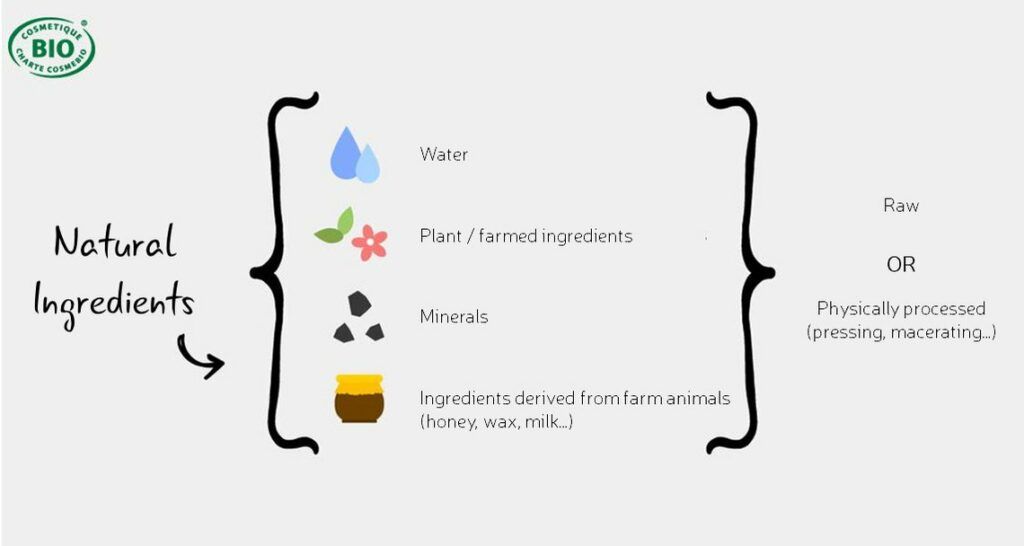
“Natural” refers to ingredients like water, minerals, and those sourced from plants or livestock that have not been chemically processed.
This includes ingredients such as herbal extracts and essential oils, honey and lanolin (sheep wool wax), or sea salt. These ingredients may be used in cosmetic products:
- In their raw form, as they were harvested
- After extraction or physical processing, such as pressing, grinding, or macerating seeds or plants.
Established by the EU, the REACH regulation (Registration, Evaluation, Authorization and Restriction of Chemicals) provides the primary definition for natural ingredients, using the the term « physically processed agro-ingredients » (PPAI).
However, manufacturers may also use the ISO 16128 definition or a voluntary standard like COSMOS or NATRUE.
In the USA, « natural » refers to ingredients sourced directly from nature and not synthesized in a laboratory. But the FDA has not legally defined the term and does not regulate its use.
Natural products
Within the EU, the evaluation of the term « natural » varies by member state and may depend on national authorities.
For instance, in France, the ARPP distinguishes between « natural » and « natural origin, » though this distinction is not global. France also requires that a finished product be described as natural only when its natural content is at least 95% of the end product.
- If a brand claims a product is 100% natural, it must provide documentation proving the formulation contains no synthetic ingredients.
- If a product contains less than 95% natural ingredients, the percentage must be indicated on the packaging or next to the relevant ingredients.
“Of natural origin”: Between Nature and Chemistry
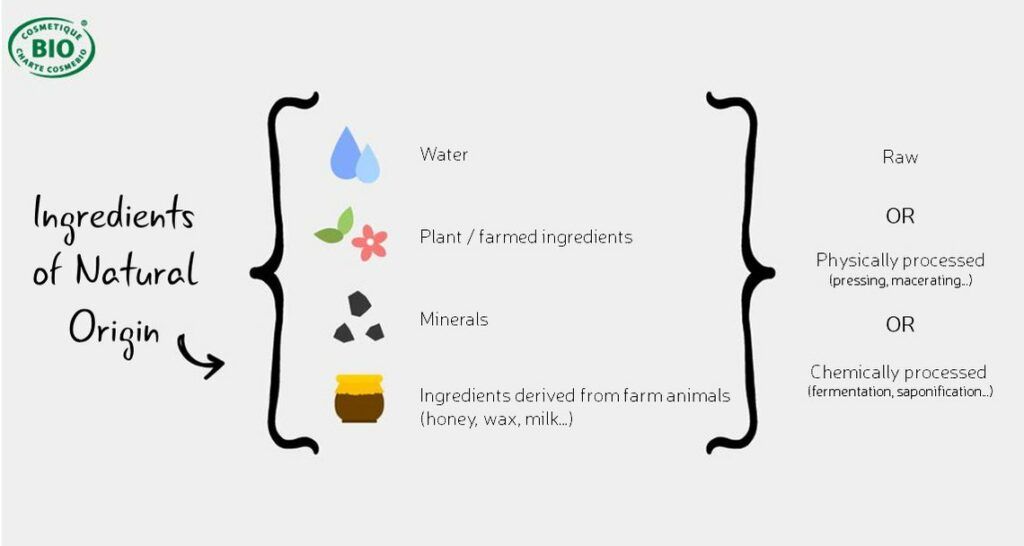
Unlike strictly natural ingredients, which are not chemically modified, “ingredients of natural origin” or “naturally derived” result from processes designed to reproduce physiological, biochemical, or refining reactions.
Such ingredients are widely used in cosmetic formulations because they offer greater formulation flexibility than raw natural substances. They allow formulators to achieve textures, foaming properties, preservation, and shelf stability that would be difficult or impossible to obtain using only non-modified natural ingredients.
These transformations are explicitly listed and regulated within private certification standards and guidance frameworks, notably ISO 16128 and labels such as COSMOS or NATRUE.
For example, soaps, including handmade types, cannot be classified as natural because they undergo saponification. Saponification, the process of soap making, is in fact a chemical reaction between a fat (oil, butter, etc.) and a lye. It is classified as naturally derived, and the percentage of natural ingredients can be indicated on the product.
Standards and Voluntary Frameworks
In the absence of a legally binding international definition of “natural” and “organic” cosmetics, private and voluntary standards have emerged to provide consumers with guarantees regarding product composition and quality.
Labels such as NATRUE or COSMOS rely on their own certification frameworks, defining specific requirements for ingredient origin, the percentage of natural and organic content, and authorized transformation processes. Their purpose is to increase transparency in a market where regulatory definitions remain limited.
ISO 16128 Standard
ISO 16128 is an international standard that provides a structured framework for defining natural and organic cosmetic ingredients based on their origin and processing methods. Developed by experts from over 40 countries within the International Organization for Standardization (ISO), it aims to harmonize definitions and calculation methods worldwide.
The standard establishes clear categories for natural, organic, mineral, and synthetic ingredients and provides methodologies to calculate the percentage of natural or organic content in finished products. However, ISO 16128 is not a regulatory standard and does not restrict formulation choices or prohibit any ingredients. It focuses solely on quantifying natural and organic content, without assessing the environmental or health impact of substances.
As a result, a cosmetic product may contain a high percentage of natural-origin ingredients while still including synthetic compounds such as silicones or parabens.
Regulatory Law, Voluntary Standards, and Greenwashing
The lack of unified international standards allows greenwashing. For example, companies may emphasize a single natural ingredient in marketing, even if it makes up only a small part of the final product. This strategy is used not only for “natural” and “organic” claims but also for broader terms such as “green,” “clean,” or “environmentally friendly.”
Certifications such as COSMOS and NATRUE actively combat greenwashing by imposing stricter requirements, independent audits, and greater transparency.
Market Surveillance
In France, the Directorate General for Competition Policy, Consumer Affairs and Fraud Control (DGCCRF) monitors cosmetic products and verifies the accuracy of consumer information. A 2019 investigation revealed insufficient substantiation, traceability issues, and undeclared prohibited substances or allergens, with an anomaly rate of 24%, underscoring the need for clearer standards and stronger harmonization.
To conclude
The terms organic, natural, naturally derived, and of natural origin describe different realities based on ingredient origin, transformation, and calculation methods, and should not be used interchangeably. While widely used in marketing, these claims do not carry the same legal or regulatory weight.
The current framework remains fragmented, highlighting the need for clearer standards, greater transparency, and informed consumers. Greater harmonization at the EU level would help reduce confusion and support more consistent use of natural and organic claims in the future.
Source: https://www.cosmebio.org/en/reports/organic-natural-and-of-natural-origin-whats-the-difference-between-these-types-of-ingredients/
Sources
- https://www.cosmebio.org/fr/nos-dossiers/ingredients-cosmetiques-naturels
- https://www.neo-cosmetique.fr/blogs/actualites/les-produits-biologiques-et-naturels-et-la-norme-iso16128
- https://natrue.org/faq/
- https://www.mayoclinichealthsystem.org/hometown-health/speaking-of-health/what-are-natural-personal-care-products
- https://coslaw.eu/cosmetics-claims-when-can-you-claim-natural-organic-vegan-and-non-gmo-part-ii/
- https://www.economie.gouv.fr/dgccrf/les-fiches-pratiques/cosmetiques-bio-et-naturel