

The skin is the largest organ in the human body. Its primary role is to serve as a barrier, providing immune protection and enabling sensation.
The outermost layer of the epidermis, the stratum corneum (SC), provides this barrier function. It consists of skin cells within a lipid matrix and is formed through a multistep process of keratinocyte differentiation, where lipid metabolism is essential for both structure and homeostasis.
Some skin fatty acids are synthesized by the body or absorbed from the diet. However, polyunsaturated fatty acids (PUFAs) such as α-linolenic acid (ALA) and linoleic acid (LA) cannot be synthesized by the body and must be obtained from dietary sources or topical application. These acids participate in metabolic pathways in the basal epidermal layer, where cell proliferation occurs. At the end of differentiation, the SC lipid matrix forms, consisting of approximately 45% ceramides, 30% cholesterol, and 15% free fatty acids (ScienceDirect).
Skin lipids are essential for maintaining the skin’s structural and physiological functions, including energy supply, membrane formation, receptor activation, conversion to lipid mediators, and synthesis of complex lipids.
The content and composition of fatty acids in the skin, as well as the amount and type of fatty acids, have a significant impact on skin health and appearance.
In the cosmetic market, consumer interest in natural, safe, and healthy products has increased in recent years, and vegetable oils are widely accepted. These oils contain both saturated and unsaturated fatty acids, including polyunsaturated fatty acids (PUFAs), which are important for establishing and maintaining the skin barrier.
This article examines two PUFAs, linoleic acid and alpha-linolenic acid, focusing on their properties and potential uses.
Linoleic Acid: an Indispensable Ally for the Skin Barrier and Hydration
What is it?
Linoleic acid (LA) is a polyunsaturated fatty acid (PUFA) belonging to the family of Omega-6 that can be found in a number of vegetable oils.
At the cellular level, LA contributes to membrane composition, ensuring its flexibility and integrity. It is also a precursor to other fatty acids and affects immune function, inflammation regulation, blood coagulation, and cardiovascular responses.
It is an essential acid, meaning it is key to human physiology, but the body cannot synthesize it. Therefore, it’s indispensable to provide it daily through adapted food intakes and cutaneous application to cover the body’s daily needs.
According to Futura Science, LA is abundantly present in various botanical oils, such as hemp, safflower, corn, sunflower seed, grapeseed, soybean, sesame, and borage oils etc.
Why is it important for the skin?
LA is the most abundant PUFA in the skin. Outside of dietary concerns, LA’s use is also involved in cosmetic formulation. It is especially used in skincare formulas due to its moisturizing, repairing, and anti-inflammatory properties. Its presence in sufficient quantities is an important factor in multiple fundamental metabolic processes, including skin metabolism, growth, maintenance of the epidermal barrier, and regulation of skin hydration.
As an essential fatty acid, LA can only be acquired from the diet or extra cutaneous sites and transported across the plasma membrane. Important to cell regeneration processes, LA solidifies their membranes, therefore retaining water intakes in the epidermis and maintaining skin hydration naturally.
It is also a precursor to certain lipids, such as ceramides. Ceramides, which account for about 40% of skin lipids, bind skin cells together and increase the skin’s flexibility and thickness. It is therefore an essential active ingredient to strengthen the cutaneous barrier.
In a nutshell, it helps restore the protective epidermal lipid barrier and improve its elasticity and suppleness, making it a prime ingredient in skin care products for dry or allergy-prone skin (atopic skin).
Cosmetic properties
Restores the skin barrier
LA intake is directly linked to ceramide production, which is essential for skin health. In sufficient numbers, ceramides ensure skin moisture, suppleness, and protection against irritants and pollutant particles.
On the contrary, an LA deficiency can lead to a weakened cutaneous barrier. This provokes: dryness, tightness, atopic eczema, increased sensitivity…
Supports healing of damaged skin
Scientific studies suggest that LA or LA-rich vegetable oils, when applied topically, support cell regeneration and inflammatory regulation. This leads to positive skin reactions, such as repairing the skin barrier and promoting wound healing.
Sebum regulation and acne prevention
The efficacy of LA in treating acne spots has been scientifically proven. By increasing and preserving the skin’s moisture level, LA regulates sebum production and helps acne-prone skin regain balance and heal.
As a result, the skin is clearer, with fewer spots, blackheads, and clogged pores.
It’s why some omega-6-rich oils are « non-comedogenic » despite their high omega content.
It’s also been proven that acne-prone skin, atopic dermatitis, and psoriasis are often linked to a deficit in LA or a disorder in its metabolism.
Soothing and anti-inflammatory action
LA has anti-inflammatory properties that help soothe irritations, redness, dermatitis, and inflammatory spots. Its use is therefore recommended for sensitive, reactive, and atopic skin.
Quick penetration: dry touch effect
The texture of oils with a high Omega-6 content is usually lighter and thinner. They are quickly and deeply absorbed by the epidermis and don’t leave a fatty layer on the skin. This makes them well-suited for use on the face, as serums or for oily and combination skin.
Compatible with most skin types
LA is adapted to most skin types :
- Dry or damaged skin: promotes skin hydration and repairs the skin barrier
- Oily or combination skin: participates in sebum regulation
- Sensitive and atopic skin: acts as an anti-inflammatory
- Mature skin: strengthen weakened skin barriers
BONUS: supports haircare and growth
LA and LA-rich vegetable oils benefit hair growth and hydration. How? LA influences the hair follicle growth cycle by regulating critical signaling pathways and inducing the release of growth factors.
Weak point: the oxidation
LA is highly oxidizable and must be formulated with antioxidant compounds. The metabolism of LA is influenced by antioxidant vitamins, such as Vitamin E, which protect PUFAs from oxidation and enhance their effectiveness. This protection is essential because Lipid oxidation in the body generates harmful compounds that contribute to cellular aging and the formation of atherosclerotic plaques. Used undiluted or oxidized, LA can be very irritating to the skin.
α-linolenic acid: the fatty acid that nourishes and soothes the skin
What is it?
α-linolenic acid (ALA) is a plant-based polyunsaturated fatty acid (PUFA) that belongs to the family of Omega-3. Like linoleic acid, ALA is an essential fatty acid that is indispensable to the body and must be provided in sufficient quantities through food intake and skin application.
ALA is also a precursor for other Omega-3 such as EPA (eicosapentaenoic acid) and DHA docosahexaenoic acid) – usually found in fatty fishes and algae. These two PUFAs contribute to the production of anti-inflammatory molecules, thereby supporting the proper function of the cardiovascular system and good eyesight.
ALA can be found in numerous vegetable oils, such as linseed, hemp, and rapeseed oil, and in certain nuts and seeds, such as walnuts and linseed.
Why is it important to the skin?
In the cosmetic market, we see growing interest in developing topical formulations of omega-3 PUFAs for skin health. But why is it so interesting? ALA is even more effective than LA for treating skin-inflammation disorders.
In 2018, a systematic review reported the beneficial effects of cutaneous application of fatty acids, especially ALA, LA, DHA, and EPA. The author concluded that these 3 PUFAs demonstrated efficacy in:
- improving skin barrier function
- inhibiting UV-induced inflammation and hyperpigmentation
- attenuating dry skin and pruritus elicited by dermatitis
- accelerating wound healing
Topical application of ALA shows positive effects on skin health in various conditions, including psoriasis, irritation and inflammation, wound healing, and hydration.
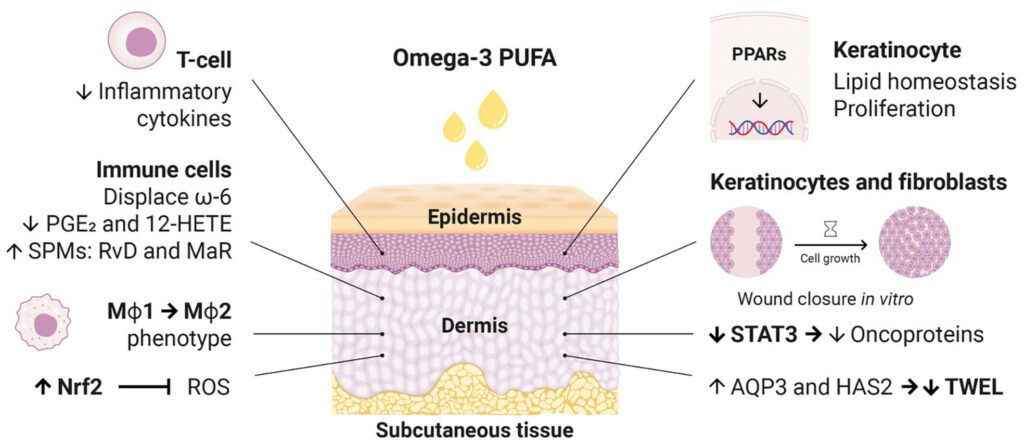
ALA enhances skin hydration by reducing transepidermal water loss, which helps prevent dermatitis. An action of two layers of the skin :
- At the epidermal level, ALA contributes to lipid homeostasis, keratinocyte proliferation, modulation of peroxisome proliferator-activated receptors (PPARs), which are essential for maintaining skin barrier permeability and regulating skin inflammation, and a decrease in inflammatory cytokines.
- In the dermis, ALA exhibits multiple effects on keratinocytes, fibroblasts, immune cells, and macrophages, influencing signaling pathways.
Oral supplementation has also proven to be efficient.
Oral supplementation of Omega-3 PUFAs provides benefits for several skin conditions. These include psoriasis, atopic dermatitis, acne, and wound healing in burn patients.
Some of the cosmetic properties of ALA are:
- Soothing sensitive and inflamed skin
- Diminishing redness, blemishes, irritations, and rosacea
- Anti-aging action by supporting skin suppleness and limiting micro-inflammation
- Skin repair, especially after UV exposure
- It can also support irritated scalps and weakened hair.
In a nutshell, ALA-rich oils are protective, nourishing, and lightweight. They are quickly absorbed into the skin and help soothe damaged and sensitive skin.
Just like LA, ALA supports skin moisture, barrier, and repair. Studies have shown an even better effectiveness. But the ingredients are even less stable and more prone to oxidation.
Weak point: even more oxidative
Highly oxidative: ALA, as well as DHA and EPA, is highly susceptible to oxidative degradation. This fact has led to the development of micro and nanoparticles to include the molecules and enhance their bioavailability.
Strong smell
ALA-rich oils tend to have a stronger scent than others, which can disrupt the overall use of the product by the end-consumer.
What about Γ-linolenic acid?
Most of the time, when « linolenic acid » is listed in a formula, it refers to alpha-linolenic acid (omega-3), which is more commonly used in skincare and skin oils.
But for some products targeting very dry or atopic skin, gamma-linolenic acid (omega-6) may be listed as an ingredient, in the form of a vegetable oil such as borache or evening primrose.
Gamma-linoleic acid (GLA) is another kind of PUFA that belongs to the omega-6 family, and that can be found in borage oil, evening primrose oil, and blackcurrant oil.
Oils rich in GLA are anti-inflammatory, restorative, and reduce the appearance of scars. They help maintain skin hydration by retaining water in the cells and improving the skin’s barrier function. These oils are absorbed very quickly without leaving a greasy residue.
Cosmetic properties
- Strengthen the skin barrier.
- Decreases dryness, irritation, and inflammation
- Adapted to atopic, eczema-prone, and mature skin
LA and ALA: select, replace, or combine?
So on the one hand, linoleic acid (LA, Omega-6) moisturizes, repairs, and regulates sebum production. It is a perfect ally for most skin types, especially combination, oily, acne-prone, and dry skin.
On the other hand, α-linolenic acid (ALA, omega-3) soothes and repairs the skin and acts as an anti-inflammatory. It is perfectly suited for sensitive, irritant-prone, redness-prone skin, or after UV exposure.
In a nutshell, they share a lot of properties:
- They’re both essential to maintaining and strengthening the skin barrier.
- They promote deep skin hydration.
- They help wound healing.
- They decrease local inflammation.
- They are some of the most tolerated ingredients for sensitive skin.
- And the support of hair follicle regeneration
Should you use one or the other, or both of them combined?
Studies show that it’s not so much a matter of omega-6 or omega-3, but of the right proportion between both.
On Science Direct, you can read «LA is the most abundant PUFA present in the epidermis and is well known to influence skin permeability through its incorporation into ceramides. On the other hand, ALA has never been documented to influence skin permeability, although it is recognized as implicated in skin homeostasis, as it is the precursor of long-chain n-3 PUFAs. Additionally, ALA (…) possesses potential anti-inflammatory action in diverse diseases. Therefore, these previous results highlight the importance of the n-3 to n-6 PUFA ratio in cutaneous homeostasis. »
The author suggests that dual supplementation with LA and ALA decreases the permeability of the skin substitutes to testosterone, showing an improvement in skin barrier function after lipid supplementation, and thereby suggesting that lipid supplementation mainly influences the lipid content of the skin substitutes.
The author writes, « While individual supplementation with ALA previously pointed toward the importance of omega-3 PUFAs in the establishment of the skin barrier, the present study shows that omega-6 PUFAs, and more specifically LA, play a crucial role in the skin barrier function and that they need to be used in combination with omega-3 PUFAs for optimal incorporation and metabolization by the reconstructed tissue. »
Further studies are needed to deepen our understanding of the balance of fatty acids in their topical use. But from a dietary perspective, it is known that Omega-3 and 6 compete for access to enzymes. A good balance between Omega-6 and Omega-3 intake is determinant in regulating inflammation. An imbalance favoring Omega-6, very common in occidental diets, can favor pro-inflammatory states and increase the risk of cardiovascular disease, chronic inflammatory disorders, or certain metabolic diseases. Sufficient intake of AL and a good ratio with Omega-3, present in rapeseed and linseed oil, and fatty fish, helps better prevent those diseases.
Disclaimers
The majority of studies investigating the effects of topical polyunsaturated fatty acids (PUFAs) on skin conditions are conducted in vitro, with limited clinical data available from studies involving healthy volunteers or patient populations. This limitation restricts the generalizability of the findings, as in vitro effects are often not replicated in clinical trials, and translating these results into clinical practice can be a lengthy process. Since 2013, the European Union has prohibited the sale of cosmetic ingredients tested on animals; consequently, most industrial and academic research on cosmetic ingredients relies on in vitro studies. Alternative skin models, such as human cell-based systems, reconstructed skin, ex vivo skin, organ-on-a-chip, and computational in silico models, have emerged as promising, cost-effective solutions that are more sustainable, raise fewer ethical concerns, and, in some cases, offer advantages over animal models. Nevertheless, despite these promising developments, the evidence supporting the topical effects of PUFAs in humans remains limited.
To conclude
In recent years, consumer interest in natural, green, safe, and healthy products has grown. LA and ALA, which are predominantly found in natural vegetable oils, are widely accepted among cosmetic consumers. And they are reaching the list of cosmetic ingredients that consumers know and look for, along with retinol and niacinamide. (VOGUE ARTICLE)
Potential applications in cosmetics
A serum or face oil:
- Light texture, dry-touch finish.
- Skin becomes supple, soft, and hydrated.
- Suitable for atopic and irritated skin.
- Ideal for a “protect & repair” formula.
An anti-acne lotion:
- Helps regulate sebum production.
- Reduces acne spots, blackheads, and clogged pores.
- Minimizes dryness associated with acne treatments.
An anti-aging cream:
- Helps reduce micro-inflammation.
- Enhances skin elasticity.
- Plumps skin by strengthening the barrier and improving hydration.
For haircare:
- Promotes scalp health.
- Reduces scalp irritation.
- Supports hair follicle regeneration and growth.
- Nourishes hair fibers.
Sources
- https://www.vogue.fr/beaute/article/acide-linoleique-imperfections-etude-scientifique
- https://www.sophim.com/fr/acide-linolenique/
- https://www.futura-sciences.com/sante/definitions/biologie-acide-linoleique-6561
- https://www.mdpi.com/1422-0067/26/1/246
- https://www.sciencedirect.com/science/article/pii/S1742706121007704
- https://onlinelibrary.wiley.com/doi/10.1111/jocd.70341