
The cosmetic and hygiene industry is undergoing a revolution. Growing consumer concern for health and sustainability has sparked new marketing efforts, often referred to as “green marketing.” This shift has prompted a flood of claims about product naturalness, which can be vague or unreliable.
To address the lack of regulation and transparency, consumer and industry groups developed cosmetic labeling standards.
What are cosmetic labels?
Cosmetic labels are created by certifying organizations. These are independent entities that set standards all products must meet throughout their life cycle. Certification symbols on packaging help distinguish sustainable from non-sustainable products and add value. They ensure transparency and reliability at a national level.
Cosmetic labels typically advocate natural, biodegradable ingredients that are safe for people and the environment. But a label doesn’t mean that:
- A product is 100% organic, but most hygiene products are made of water, which cannot be certified organic.
- A product is 100% natural, but most labels allow a share of synthetic ingredients in the cosmetic formula.
- A product is sustainable: some labels focus on animal welfare without considering ecological criteria.
To be labelled, a product must comply with the regulations and standards set out in a certification charter. These standards generally focus on two things:
- The type, quality, and sourcing of raw materials and ingredients,
- The manufacturing and processing techniques,
But more criteria can apply, such as :
- Sustainable, ethical, and social criteria
- A minimum % of ingredients sourced from organic farming
- The lamination or prohibition of specific toxic substances
- Animal welfare
In this article, we will deep-dive into the main labels on the market and their standards. Even though some labels are stricter than others, each label has its own set of criteria, making it impossible to rank them.

Nature & Progrès: the Label for 100% Organic Products
Nature & Progrès is an association uniting consumers, agricultural producers, and organic cosmetic manufacturers. It was created in France in 1964 with the intention of promoting organic farming methods that are respectful of the environment, biodiversity, and agricultural knowledge and network.
In 1998, an official label was created under the association name with the objective of promoting and creating products that are safe for people, animals, plants, and planet Earth.
Since then, it has become one of the strictest labels available. It requires that cosmetic and hygiene product formulas use only raw materials from organic agriculture.
A summary of their criteria:
- All ingredients must be 100% organic or ethically wild-harvested.
- No ingredients are allowed from endangered species, nor from polluted sites.
- Prohibited substances include petrochemicals, synthetic ingredients, GMO ingredients, and palm oil.
- All manufacturing processes must be mechanical (such as physical blending or grinding) or derived from simple chemical and physical methods (e.g., methods that do not create new substances, such as steam distillation).
- Criteria also cover waste management, packaging, and maintenance of premises.
- Only a few animal-based ingredients are allowed, such as milk or honey.
Some brands you might have heard of: Noire O Naturel,Au Cœur des RacinesNature & Progrès charter can be accessed on their website.
COSMOS: a Leading Label for Natural and Organic Cosmetics
COSMOS is among the most recognized labels for natural and organic cosmetics. Managed by COSMOS-Standard AISBL in Brussels, it was initiated by five European certifiers—Cosmébio and Ecocert (France), ICEA (Italy), BDIH (Germany), and the Soil Association (UK). Its goal is to standardize and streamline natural cosmetic certification across Europe.
All COSMOS-certified products follow strict rules. GMOs, nanomaterials, mercury treatments, and certain chemical processes are banned, and packaging must meet specific sustainability requirements.
Product certification is divided into two branches: COSMOS Organic and COSMOS Natural.
COSMOS Organic is the stricter label:
- 95% ingredients must be natural.
- 95% ingredients must come from organic farming or ethical wild harvesting and be mechanically processed.
- At least 20% of the final product must be organic (10% for lotions, rinse-offs, and mineral-heavy products).
COSMOS Natural is more inclusive:
- 95% ingredients must be natural, but there’s no minimum organic requirement.
COSMOS also certifies raw materials:
- COSMOS CERTIFIED: organic ingredients processed according to COSMOS standards.
- COSMOS APPROVED: non-organic ingredients allowed under COSMOS standards.
Some brands you might have heard of: Cîme,Nocibé,L:A BruketA detailed list of criteria is available on their website, along with a database of all certified products, brands, and raw materials.
NATRUE: a Label for 100% Natural Cosmetics
Natrue, officially NATRUE – The International Natural and Organic Cosmetics Association A.I.S.B.L., was founded in 2008 by European cosmetic brands. Its mission is to advocate for improved regulation of organic and natural cosmetics.
Natrue ensures that:
- 100% of ingredients used are natural (directly from plants, minerals, or animals), natural derivatives (ingredients changed by minimal processing), and nature-identical (lab-made ingredients that are chemically identical to those found in nature).
- 95% of ingredients are organic.
The label is divided into two levels of certification :
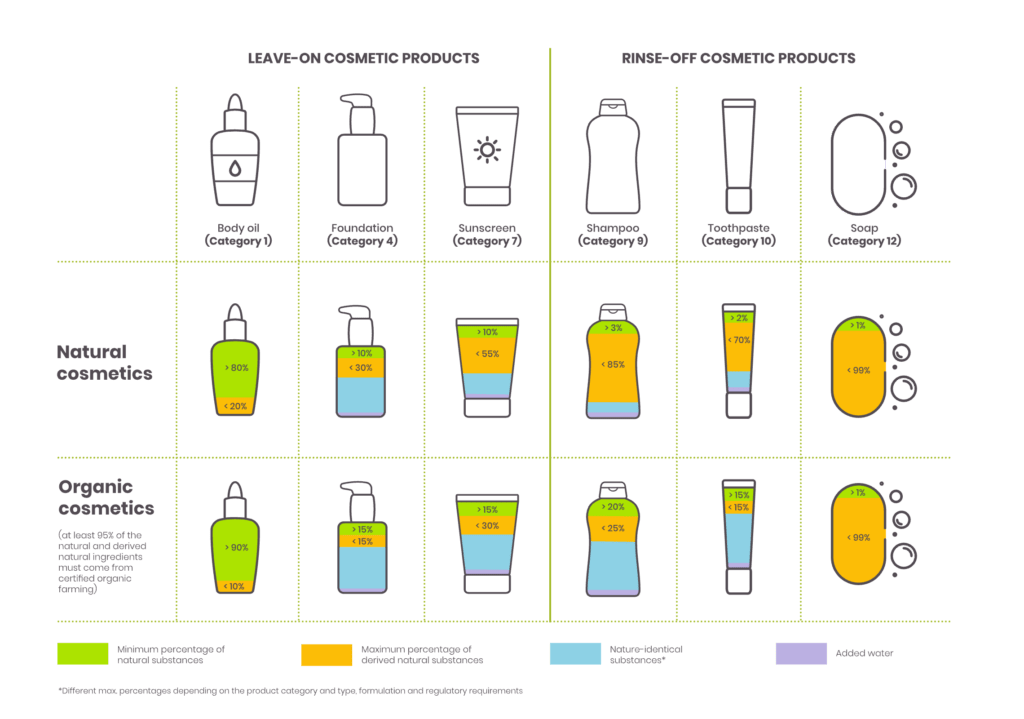
- Organic cosmetics, the strictest certification, require at least 20% of ingredients to be natural. For skincare, this rises to 90%. At least 95% of the natural ingredients must come from organic farming.
Natural cosmetics with organic compounds must have 15% to 90% natural ingredients. At least 70% of those must come from organic farming or certified wild-harvesting.
Some brands you might have heard of: Weleda,Dr. HauschkaA database of the Natrue brands and products is accessible on their website.
BDIH: The Label for Cosmetic Products made of Organic and Natural Raw Materials
BDIH is a German federal association representing 440 companies. Its members manufacture and distribute four product types: natural cosmetics, dermatologic cosmetics, raw materials, and supplements.
The German certification ensures all plant- and mineral-based ingredients are natural and promotes organic ingredients, though it does not set a minimum requirement.
The label requirements are restrictive since they include :
- A list of plant-based raw materials that must always be organic.
- A prohibition on certain ingredients: synthetic fragrances and dyes, silicone, paraffin, and petrochemicals.
Some of the criteria include :
- 100% of raw materials are of natural origin and certified.
- 100% of the plant-based raw materials are sourced from organic farming or wild-harvesting.
- Raw materials and ingredients are sourced from Fair Trade as much as possible.
- Manufacturing processes are respectful of the environment: ingredients and finished products must be safe, packaging must be sustainable and recyclable, etc.
- Prohibition of certain treatment methods, such as radioactive radiation (methods that use radiation to sterilize or preserve).
- Prohibition of animal testing and the use of raw materials derived from dead mammals (animal fats and oils, animal collagen, and new cells).
Some brands you might have heard of: Weleda,Dr. Hauschka
EU Ecolabel: the most Inclusive Label of the Industry
EU Ecolabel is a European Union initiative managed by the European Union Eco-labelling Board (EUEB) and supported by a Regulatory Committee with representatives from every EU member state.
It is the official ecological European label recognized by all EU countries. Certified products include cosmetics and hygiene items such as soaps, shampoos, conditioners, and shaving creams.
Contrary to the labels mentioned above, the EU Ecolabel is less stringent but more prevalent, even in mass supermarkets. It indicates a trend toward more sustainable, mindful consumption of cosmetic and hygiene products.
EU Ecolabel ensures :
- Fewer ingredients that are harmful to health and the environment.
- Less pollution of the aquatic world.
- Improved biodegradability of products.
- Less packaging.
- Products with proven effectiveness.
But it does not include:
- Requirements on natural or organic ingredients
- Prohibition of synthetic ingredients such as silicones.
A list of EU Ecolabel brands is accessible on their website.
SLOW COSMETIQUE: The label for Natural Cosmetic Brands
Slow Cosmetique was originally a consumer association. In 2013, the association decided to create its own label to recognize brands that focus on natural and organic ingredients, sustainable processes, local production and distribution, and healthy, reasonable marketing practices.
Its brand-focused approach is interesting because it ensures that all products manufactured by a given brand meet the same requirements, thereby providing greater clarity to consumers. A side effect of this method is that the criteria are less rigorous and demanding than those of other cosmetic labels.
The certification process is not done by an external body but by a jury of volunteer experts who evaluate brands on a certain number of points :
- 3 stars if the brand respects more than 90% of Slow Cosmetique criteria.
- 2 stars if the brand respects more than 75% of Slow Cosmetique criteria.
- 1 star if the brand respects more than 60% of Slow Cosmetique criteria.
The label charter strictly prohibits:
- The use of petrochemical oil,
- The use of formaldehyde,
- The use of ingredients requiring the death of an animal,
- The use of a fake “organic” allegation
Some brands you might have heard of: 100BON, Dr Bronner’s All One, OdenThe exhaustive list of Slow Cosmetique criteria is accessible on their website.
DEMETER: the Label for Organic and Biodynamic Products
Demeter belongs to the Biodynamic Federation Demeter International – a network of national associations from France, Germany, Brazil, etc. that creates and improves environmental standards.
The label is strict and comprehensive, and tends to go into more detail than other organic labels, since it considers processing techniques and the environmental impacts of manufacturing, packaging, and production conditions…
The range of cosmetic products labeled under Demeter is still rather restricted and mostly includes essential oils and hydrosols.
A summary of the criteria :
- Plant-based and animal-based raw materials must be derived from organic or biodynamic farming.
- All petrochemicals, fragrances other than essential oils, nanoparticles, and some manufacturing processes are prohibited.
- The negative environmental impact of the product can be reduced at every step: manufacturing, packaging, waste management, including wastewater…
- Animal testing is strictly forbidden.
- A number of social criteria to ensure safe and legal work conditions.
Some brands you might have heard of: Pranarom, Biofloral, L’Herberaie
A list of Demeter-labelled brands is available on their website.
Worth mentioning: two Labels for Animal Welfare
Even though Europe prohibits animal testing, some labels still emphasize these prohibitions to ensure compliance with this legislation in Europe and other countries.
Leaping Bunny
Leaping Bunny is a certification that ensures products and ingredients are free of animal testing. It doesn’t include any requirements regarding the environment or consumers’ health.
Cruelty-free
Cruelty-free is an initiative of the PETA association (People for the Ethical Treatment of Animals) launched in 1987. The certification ensures that the product was not tested on animals in Europe or in any other foreign market. It can also ensure the absence of animal products (honey, beeswax, milk…) in the cosmetic formula and packaging, and say “Cruelty-free and vegan”.
To conclude
As explained by Clare Carlile in an article on ethical labels: “Terms like ‘natural’ or ‘naturally-derived’ are often found on health and beauty products, leading to claims of greenwashing.”
Like many mass-consumption sectors, the cosmetic and hygiene industry is facing an increasingly wide range of ethical issues, including greenwashing.
Certifications can be a good answer to this lack of trust, as they are an important signal of ethical and ecological standards.
Conscious consumers are realizing that product claims are not always clear and are now seeking trustworthy labels and certifications to guide their purchase decisions.
Sources
- https://www.ecoconso.be/fr/content/quels-labels-reconnait-un-cosmetique-ecologique
- https://www.ethicalconsumer.org/health-beauty/ethical-labels-organic-and-natural-cosmetics
- https://www.idealo.fr/mag/lifestyle/cosmetiques-ecoresponsables-a-quel-label-se-vouer
- https://vert.eco/articles/produit-cosmetique-naturel-biologique-ou-vegan-comment-distinguer-vrais-labels-et-marketing-deguise
- https://www.researchgate.net/publication/364046404_Current_regulatory_and_market_frameworks_in_green_cosmetics_The_role_of_certification